

Interactive Test Zone
Initial shifts for real tests
These are the fundamental shifts of the reference image, in source-image pixels. In real mode, these values replace the synthetic shift angle/norm when estimating affinities and rectifying the uploaded deformed image.
After loading the two images, use the same pipeline: Autocorrelation → Detect Peaks → Validate Affinity → Rectify / Show Rectified Patches / Show Triangulation.
Validated local rectifications
No validated patch yet.Active l’autocorrélation avec le bouton dédié. Déplace la souris sur l’image pour voir la zone locale. Utilise la molette pour changer la taille du patch. Clique sur les valeurs bleues des sliders pour entrer une valeur exacte. Utilise S pour alterner entre Autocorrelation et Laplacian of Autocorrelation. Utilise Detect Peaks pour afficher uniquement les pics trouvés. Clique pour verrouiller un patch, ajuste sa taille, puis clique sur Validate Affinity quand les pics affichés par Detect Peaks sont corrects. Répète l’opération sur plusieurs zones. À chaque validation, la paire d’affinité est choisie automatiquement parmi les 6 possibilités par corrélation de phase avec l’image originale. Utilise Show Rectified Patches pour vérifier localement chaque patch redressé, puis active Rectify pour le redressement global. Utilise ← / → pour changer le contraste d’affichage dans la fenêtre.
Abstract
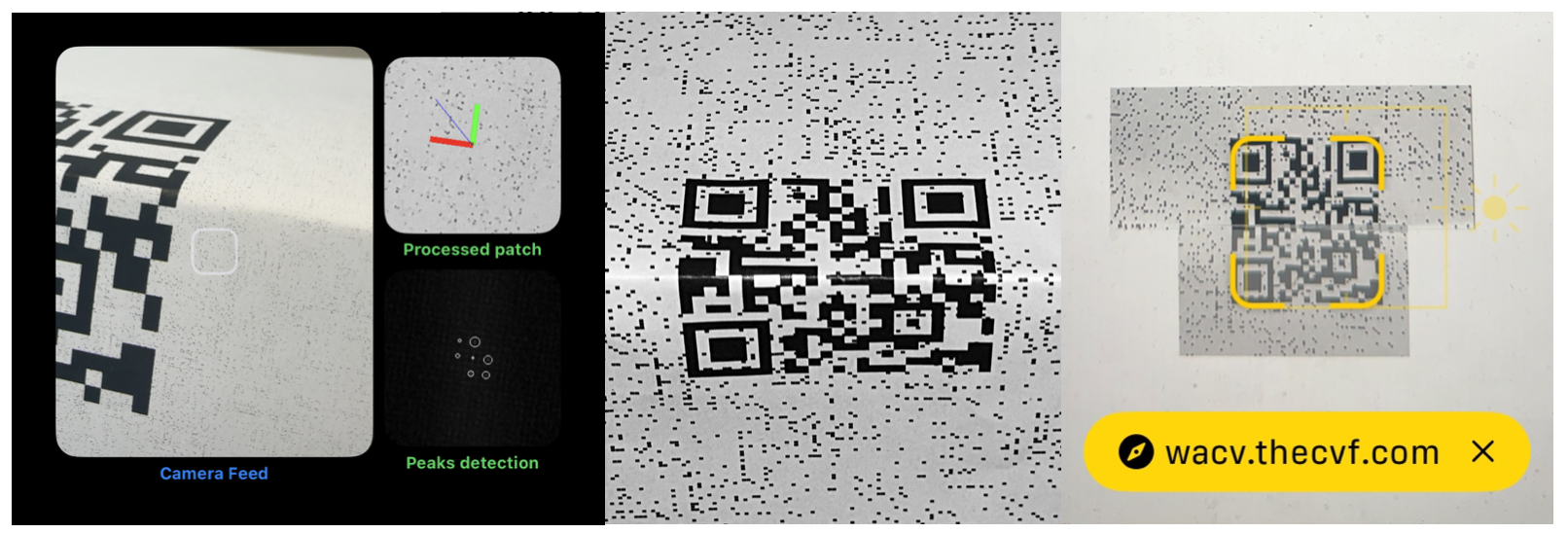
Classical single-image rectification methods usually rely on conspicuous landmarks or printed markers that can be degraded, removed, or visually alter the surface they protect. In this work, we propose autocorrelation-based fiducial markers for traceability. Our approach relies on textures whose local normalized autocorrelation exhibits a characteristic hexagonal structure, allowing the recovery of local geometric information from a single image. From these local observations, we estimate affine distortions and aggregate them to infer a global rectifying transformation. This framework is particularly relevant for traceability applications on packaging and bottles, where surfaces may be planar or curved and where visually intrusive codes are undesirable. The proposed method opens the way to robust and discreet identification patterns that remain compatible with challenging real imaging conditions.
Motivation
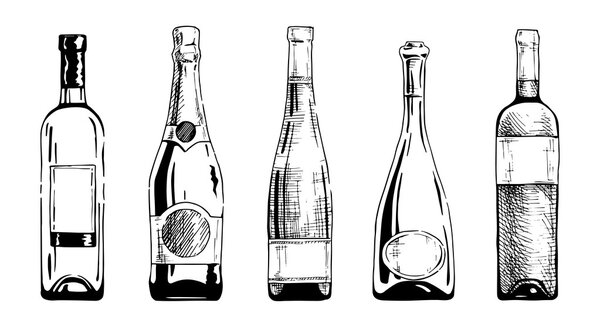
In traceability applications, traditional visible identifiers such as QR codes or barcodes can be intentionally degraded, removed, or replaced. This issue is especially critical for high-value products such as wine bottles, where resale practices may rely on tampering with visible identifiers. Our goal is to design discreet fiducial textures that remain informative for geometric recovery while being harder to tear off or visually alter.
The problem becomes even more challenging on curved objects such as bottles, where perspective effects and surface curvature deform the observed texture. This motivates a method that estimates local geometric distortions from autocorrelation peaks and uses them to recover a meaningful global rectification.
Method Overview
Our method starts from specially designed textures whose autocorrelation reveals a fundamental hexagonal arrangement of peaks. These peaks encode local geometric information and make it possible to estimate local affine distortions from image patches. We then combine these local estimates across the image to recover a global geometric model and rectify the observed texture.
This approach is particularly useful when explicit landmarks are unavailable or undesirable, and when the texture may be observed under strong deformation, including non-planar settings.
Results
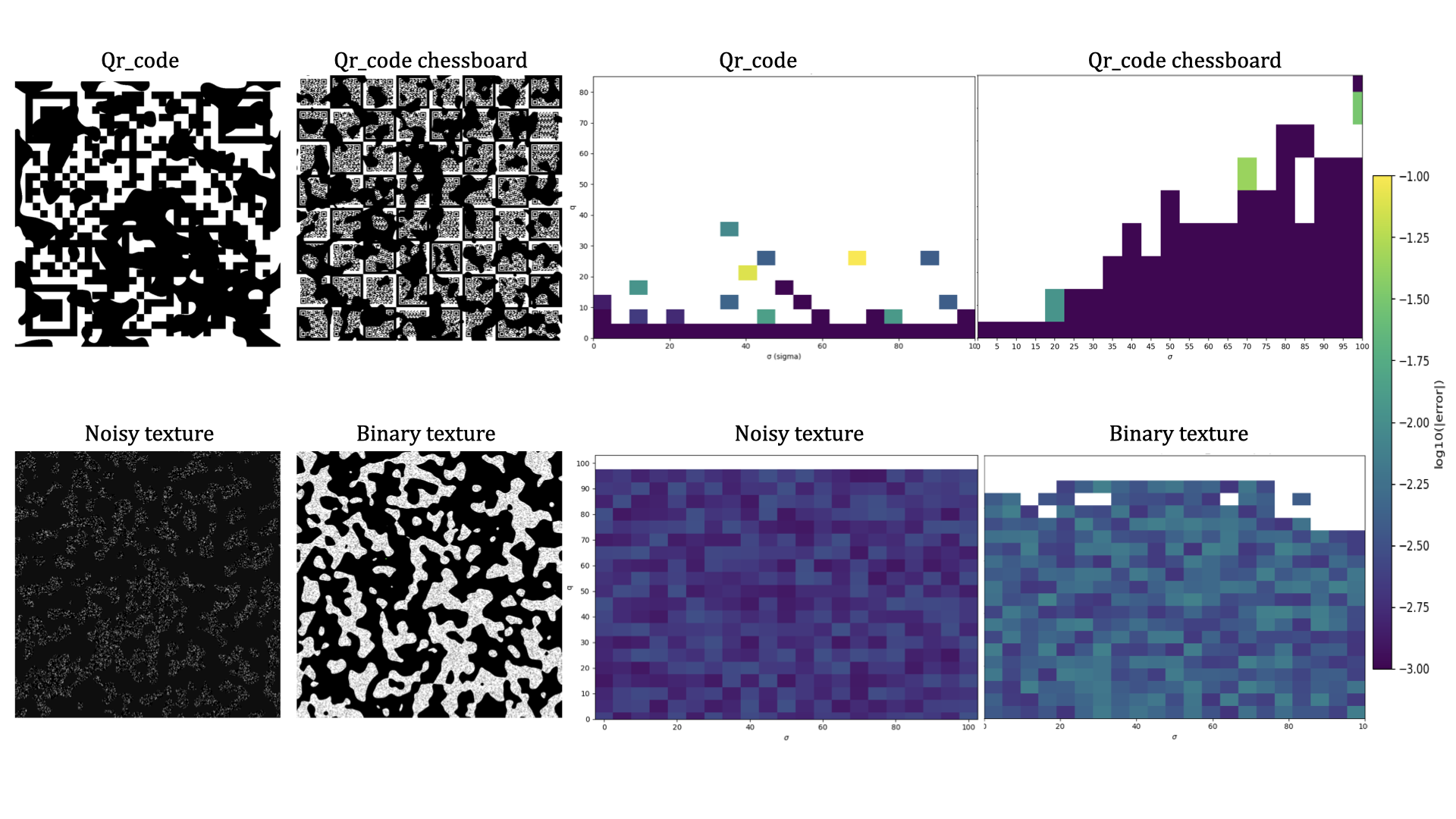
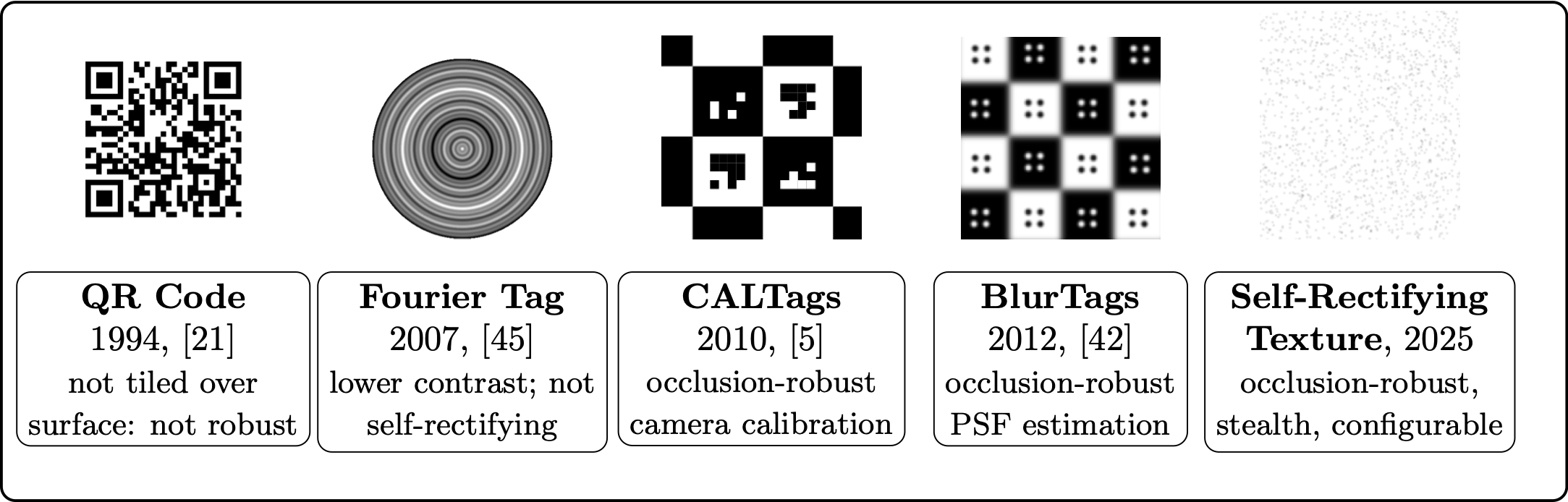
Self-rectifying textures VS Classic fiducial markers: Occlusion.
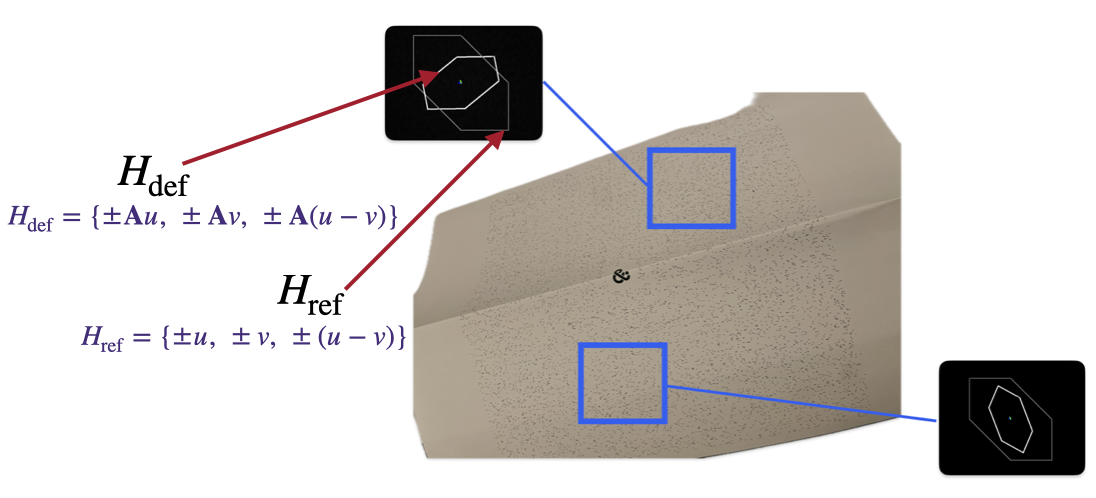
Example of a generated fiducial texture and its characteristic autocorrelation structure.
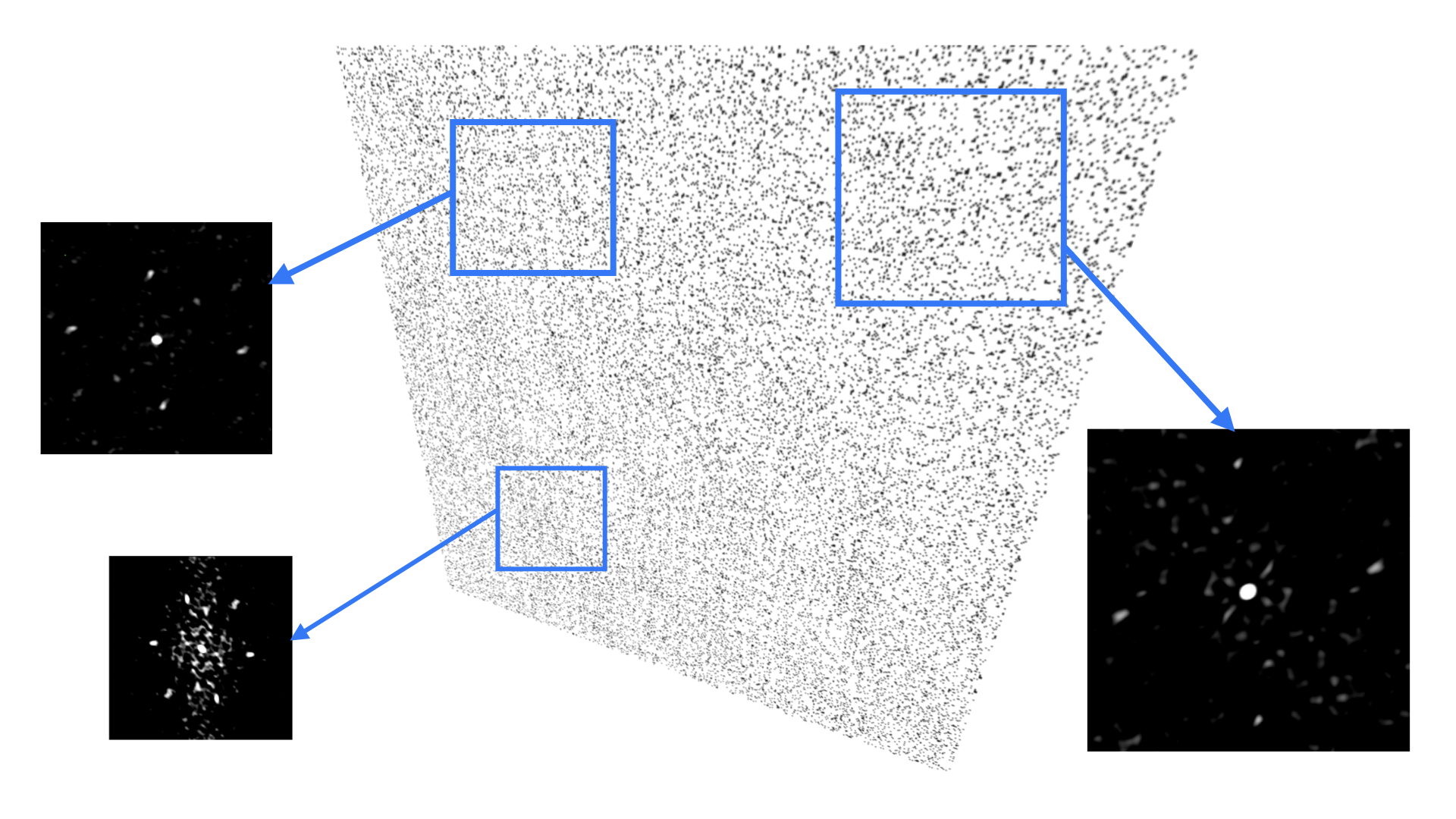
Local estimation of geometric distortions from autocorrelation peak configurations.
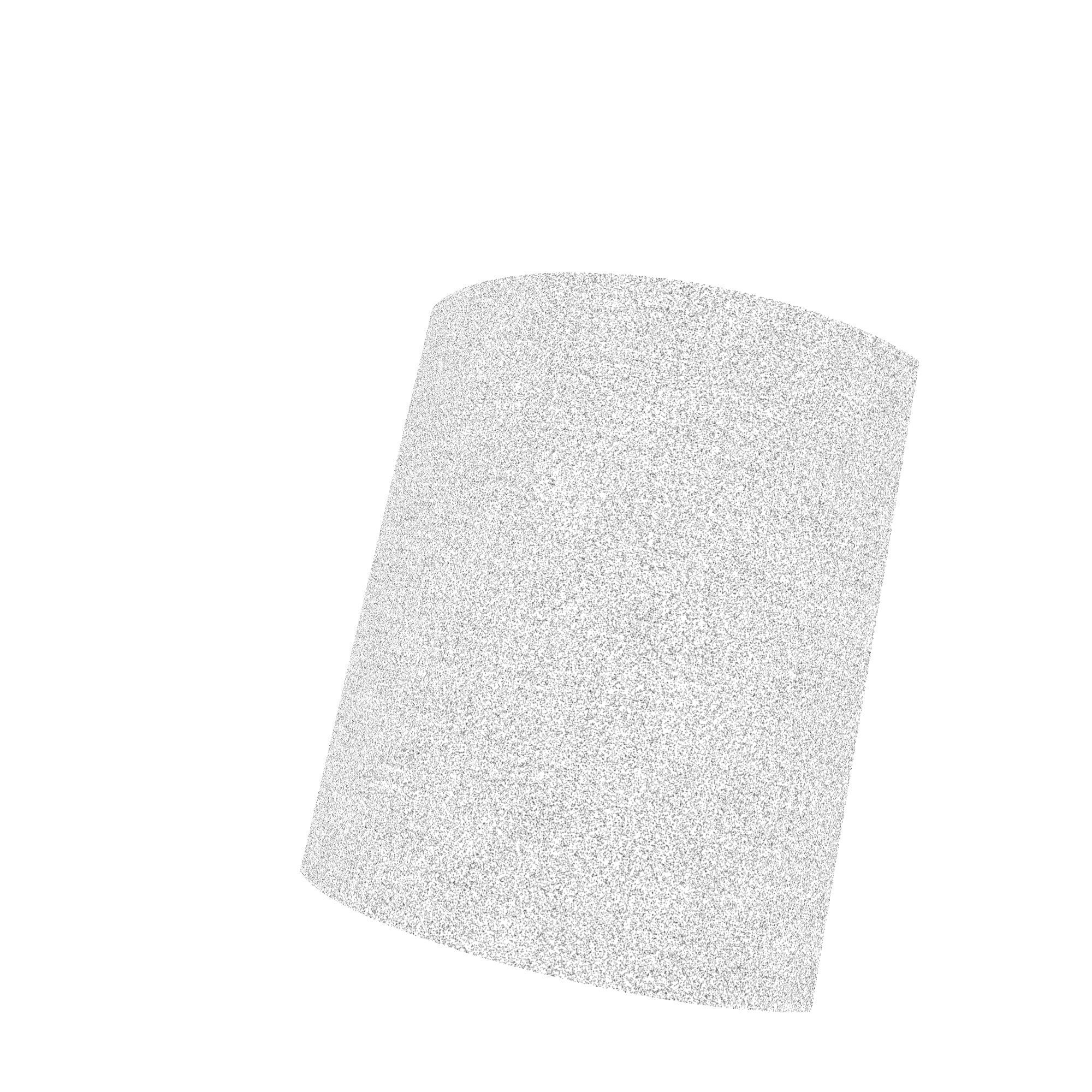
Illustration on curved surfaces, motivating robust traceability on bottles and packaging.
Video Presentation
If the embedded player does not load, open the video directly here: YouTube link.
Poster
BibTeX
@inproceedings{bencheikh2026autocorrelation,
  title     = {Autocorrelation-based Fiducial Markers for Traceability},
  author    = {Bencheikh, Ismail and Dunitz, Max and D’AUTUME, Marie and Meinhardt-Llopis, Enric and Pic, Marc and Facciolo, Gabriele and Musé, Pablo},
  booktitle = {Proceedings of the IEEE/CVF Winter Conference on Applications of Computer Vision (WACV)},
  year      = {2026},
  url       = {https://benchismail.github.io/WACV2026/}
}